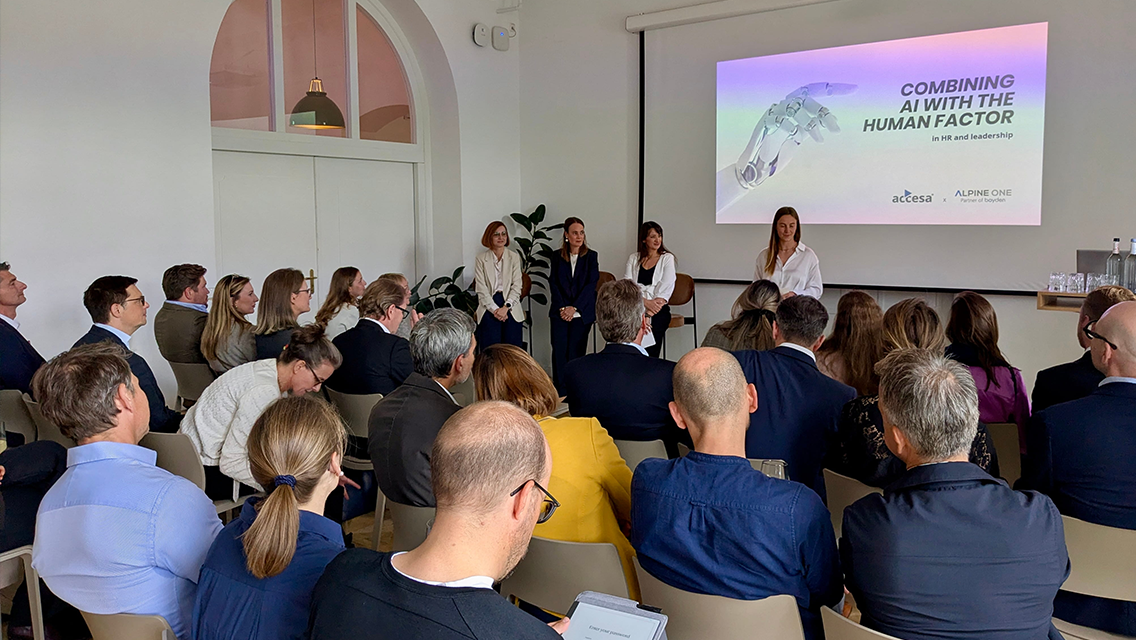
Financial institutions are investing in AI, yet many are still struggling to turn that investment into real business value. According to research referenced during the roundtable, only 5% of organisations are generating real value from AI at scale. While the technology continues to advance, organisations are still working out where to focus, how to prepare their people and processes, and what foundations need to be in place before AI can deliver meaningful results.
These ideas were the main focus points at the Executive Roundtable: AI & Leadership, hosted with our partners at Alpine One in Munich. Bringing together leaders from the Financial Services, Retail, and Manufacturing industries, the event focused on a simple but important idea: organisations create the greatest value from AI when leadership, people, processes, and data evolve alongside the technology.
Bringing Together Leadership and Technology
Building on these ideas, the Executive Roundtable brought together different perspectives on leadership, organisational change, technology, data and AI. The event provided an opportunity to explore how organisations can move from AI as an ambition to measurable results, while addressing the practical challenges that often stand in the way of adoption.
The same perspective shapes our collaboration with Alpine One. By combining our expertise, together, we help financial institutions navigate change, develop new capabilities, and modernise their technology landscape while balancing innovation, security, and compliance. These perspectives help organisations address the challenges that often stand in the way of AI adoption, from developing new skills and adapting ways of working to improving processes and making better use of data.
From Discussion to Action
Throughout the evening, the discussion focused on a number of challenges that businesses continue to face.
As investment increases, many organisations are in the process of assessing where AI can create value and what it takes to realise that value across the business.
These discussions highlighted several recurring themes that offer a practical perspective on the areas leaders should focus on as they shape the next stage of their AI journey, with three key insights standing out in particular.
AI is a leadership challenge before it is a technology challenge
One of the strongest messages from the roundtable was that successful AI adoption starts with leadership. While technology continues to evolve, organisations often find that people and ways of working do not change as quickly.
Beyond leadership, the discussion also focused on people's ability to adapt to continuous change. As technology evolves at a rapid pace, organisations are no longer defined only by the skills their people have today, but by their willingness and capacity to learn new ones tomorrow. Building a culture that encourages curiosity, continuous learning and adaptability is becoming just as important as adopting the technology itself.
As Manuela Herrlein, Managing Partner and Co-Founder at Alpine One, put it, the question is no longer which skills someone has today. The question is whether someone has the capacity to learn different skills tomorrow.
As a result, many AI initiatives fail to deliver the expected value because organisations are still working out how to approach change, build new capabilities and create the right conditions for adoption. Research shared during the event highlighted a clear difference between organisations that succeed with AI and those that struggle. While almost all top performers have active C-suite involvement, only a small percentage of lagging organisations can say the same.
For leaders, this means engaging directly with AI and understanding its impact on their teams, processes and decision-making, rather than treating it as a technology initiative owned by a single department.
AI is not an HR project. Not an IT project. Not a digital transformation side-project. It's a leadership decision about how your company works, end to end, says Alina Tirla, Managing Director Financial Services & Managed Services, CCO at Accesa.
The real challenge lies in people and processes
Another important theme throughout the discussion was that organisations often focus on technology first, while the biggest challenges are usually elsewhere.
The roundtable explored the idea that creating value from AI is about reviewing existing processes, adapting ways of working and helping people build the skills needed to work alongside new technologies.
You don't bolt AI onto your current organisation. You redesign how workflows work within it, says Alina Tirla, Managing Director Financial Services & Managed Services, CCO at Accesa
Research shared during the event highlighted that organisations creating the strongest results from AI focus only 10% of their effort on algorithms and 20% on technology and data, while 70% is dedicated to people, organisation and processes. This reinforces the idea that technology alone cannot deliver meaningful impact.
The model is the easiest part. Organisational clarity about process, data and structure is where it starts, says Maria Irimias, Portfolio of Services Lead at Accesa.
Data and process foundations matter more than new tools
Throughout the roundtable, the importance of getting the foundations right before introducing new technology was highlighted as well.
AI readiness is not simply a technology question, as organisations first need to understand their processes, identify where automation can add value and ensure the data supporting those processes is accessible, reliable, and fit for purpose. This is particularly important in complex environments where systems, processes, and regulatory requirements must work together.
For organisations looking to scale AI, success depends on building strong data and process foundations that can support long-term adoption and growth.
Looking Ahead
The conversations in Munich highlighted that there is no single path to successful AI adoption. Every organisation faces different challenges, but the themes discussed throughout the evening showed that leadership, people, processes, and data remain the main points of our journey.
AI is no longer an experiment in Financial Services; it’s an operating model decision. Organisations that succeed are the ones that treat AI as a core part of how they run their business, not as a layer added on top. That’s where real, measurable value starts to emerge, and this latest roundtable was a valuable opportunity to explore how leading organisations are putting this into practice, says Diana Brandusan, Tribe Lead at Accesa.
The conversations at the roundtable highlighted a common goal shared across the Financial Services industry: turning AI investment into meaningful business outcomes. If your organisation is navigating similar challenges, we would be happy to continue the conversation.
Together with our partners at Alpine One, our experts are always prepared to share experiences, discuss ideas, and explore practical approaches to creating meaningful value and impact within organisations.
:format(webp))
:format(webp))
:format(webp))