Many organisations have been using automation for years to relieve pressure on their teams, usually focusing on isolated steps in more complex processes. But automation delivers the greatest value when it is approached as a business capability rather than a standalone technology initiative.
Our partnership with UiPath, which began in 2018, has been built on this idea: helping organisations streamline operations, make faster decisions, and create space for people to focus on higher-value work.
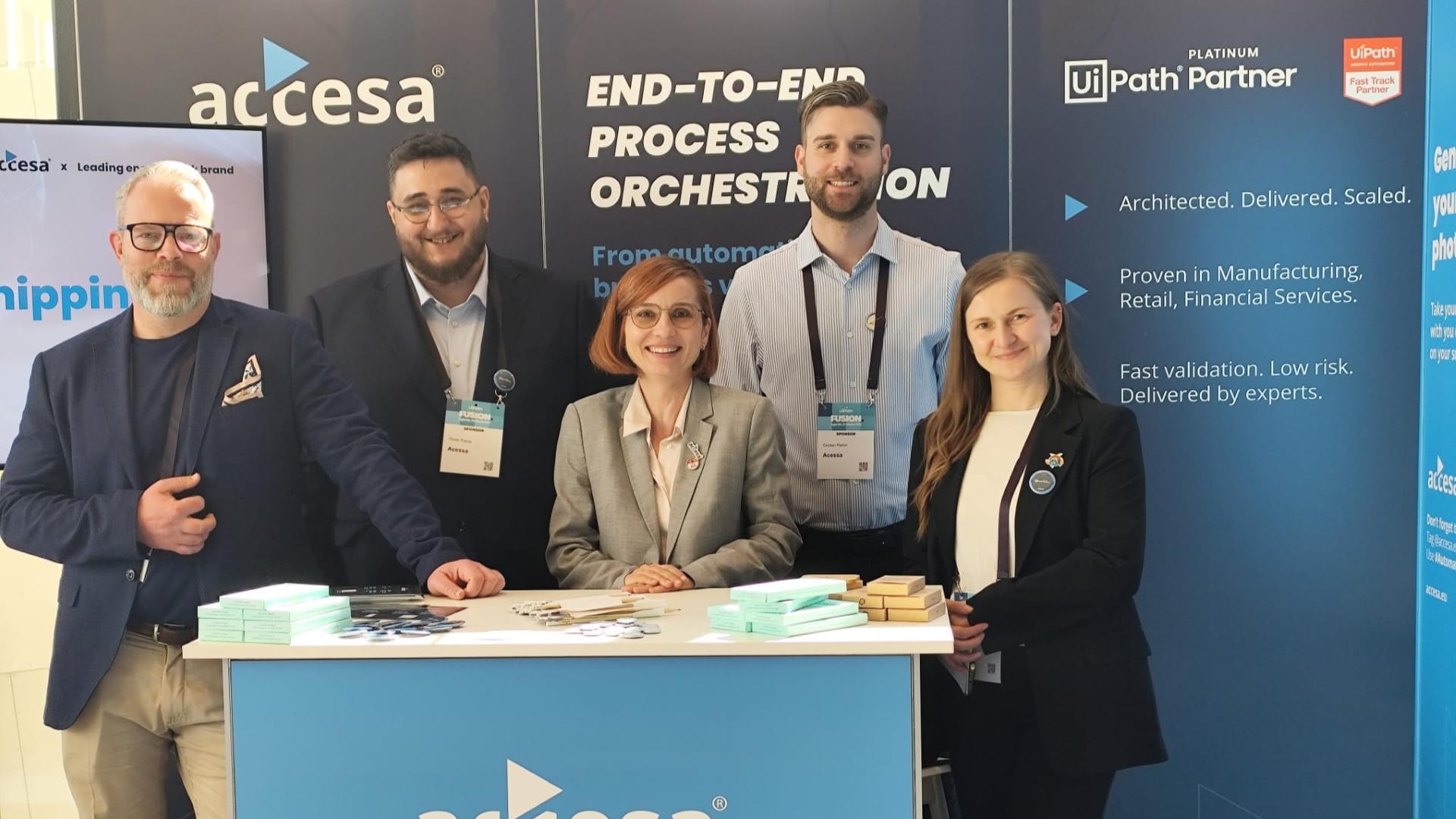
Over the years, that partnership has evolved alongside the automation landscape itself. What started with robotic process automation (RPA) has expanded into end-to-end orchestration, where robots, AI agents, systems, and people work together in coordinated business processes. In 2025, Accesa was awarded the UiPath Agentic Automation Fast Track Partner badge in recognition of the early, hands-on efforts of our teams in designing and applying agentic automation solutions within the UiPath ecosystem.
This year, we have also become a UiPath Platinum Partner as well.
That investment is best seen through our work. In this article, we will go over two orchestration projects that showcase the business value and benefits of automation when it is integrated into the organisation’s business logic itself:
01. Orchestrating Credit Risk Analysis at Scale
The first success story, developed for a major multinational integrated oil, gas, and petrochemical company, orchestrates a complex credit risk assessment process spanning more than 15 countries and over 50 customer portfolios.
By coordinating data integration, business rules, and system updates across twelve robots, the automation supports credit decisions involving more than €1 billion in requests annually.
By orchestrating multiple automation components into a cohesive process, we were able to automate 75% of credit limit requests, substantially reducing the need for manual labour and increasing processing speed, with 90% of requests now being generated in under five minutes.
The project illustrates how automation can support large-scale decision-making in environments where speed, consistency, and governance are essential. Enterprise automation is not limited to repetitive back-office tasks. When orchestrated effectively, it can handle high-volume, business-critical processes with measurable operational impact.
02. Agentic AI for End-to-End Shipping Orchestration
The second success story, a Proof of Concept for a leading energy drink brand, is a shipping assistant and addresses a different but equally powerful use case: shipping request management.
The solution is a Microsoft Teams-native assistant, orchestrated end-to-end with UiPath Maestro. Users initiate a shipping request directly in Teams, and the system coordinates every subsequent step through a single continuous workflow.
Utility and automated support become more accessible than ever, integrated into people’s existing ways of working. The solution both lowers the chances for errors and waste while simplifying work for employees:
The user makes a request in Teams.
The agent retrieves and enriches contextual information.
It validates the request against company policies with the user.
It gathers shipping options and real-time costs and recommends the optimal option.
The user chooses their preferred shipping option.
The AI generates and stores the shipping label.
The agent works through several interfaces to set everything up, but for the user, it all happens in a Microsoft Teams chat. The result is more than an automated task. It is an intelligent, policy-aware process that delivers recommendations, validates compliance and logs requests.
This solution demonstrates how conversational AI, autonomous agents, and robotic automation can work together as a coordinated process, transforming a routine request into a seamless business experience.
From Proofs of Concept to Scalable Business Outcomes
Although these success stories address very different use cases, they share the same architectural principle: technologies deliver the most value when they are orchestrated around business outcomes.
The Credit Limit Requests solution demonstrates how orchestration can support complex, high-volume credit decisions across multiple countries and portfolios. The Shipping Assistant demonstrates how agentic AI, compliance rules, and automation can be combined to create a user-friendly process embedded directly into everyday collaboration tools.
Both examples reflect how we approach automation at Accesa:
Start with a clearly defined business process.
Validate ideas through working proofs of concept.
Build for governance, scalability, and traceability.
Expand with confidence once the value is proven.
Why Trusted Technology Partnerships Matter
Automation and orchestration initiatives often involve more than technology implementation. They require architectural decisions, business understanding, and a practical path from experimentation to enterprise scale.
Working with a powerful platform such as UiPath, combined with an experienced implementation partner, helps organisations navigate this journey more effectively. It provides access to proven tools, tested methodologies, and the expertise needed to connect AI, automation, and human decisions into reliable business processes.
For us, the goal is straightforward: to help organisations move beyond isolated automations and build operational capabilities that are scalable, governed, and designed to evolve with the business.
These two demos are examples of what that journey can look like when orchestration is placed at the centre.
Is your company exploring automation and orchestration options to create measurable business outcomes? Let’s explore the process challenges you’re facing and come up with a solution.
:format(webp))
:format(webp))
:format(webp))